
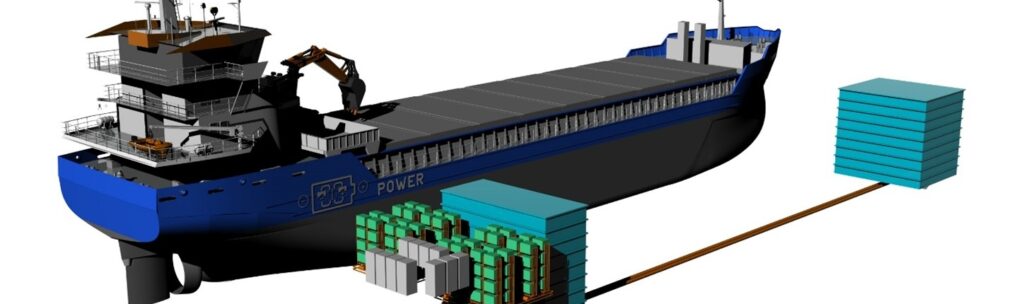
Battery-Powered ship by Bob Hillen
At our company we always host one or more interns, with a mutual goal: they can learn from us and we from them. We aim for a diverse group, different backgrounds in study and nationality. In December 2020 Bob Hillen, student of TU Delft Master Marine Technology, joined us for his graduation project. The objective of his research was to deliver a ‘proof of concept’ for the operational and economical feasibility of vanadium bromide redox flow battery-powered shipping.
“To reduce GHG and pollutant emissions, within the maritime industry, Conoship International has designed a zero-emission battery-powered ship for application within the short sea shipping (SSS) market. The energy source of this ship is a vanadium bromide redox flow battery system, as a result emission-free operations is achievable. The technology of redox flow batteries has been proven in land-based applications, however in shipping it is still unknown.
An elaborate analysis of historical voyage data has been carried out to determine operational feasibility. To determine economic feasibility, a cost-comparison model has been constructed, including the capital, operational and voyage related expenses. Then a case study method, including scenario analysis, has been used to determine under which circumstances a battery-powered Conoship is cost-competitive with diesel-powered ships.” says Bob.
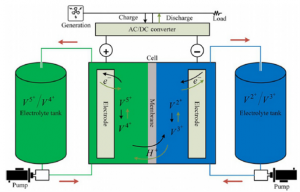
All Vanadium Redox Flow battery working principles
His research has contributed to increasing scientific knowledge of the operational possibilities of limited range sailing for the general cargo SSS market. The strength of this research into the economical feasibility, with means of a cost-comparison model is that: the variables in the model can be changed to determine for different (circumstances) scenarios when battery-powered ship is cost-competitive with a diesel-powered ship.
In conclusion, it’s operational feasible to operate a battery-powered ship with a maximum range of 650 nautical miles. This research shows that it could be economical feasible provided that other factors, such as the implementation of a CO2-tax, are addressed in the near future.


