
Risk Bases Designs for Innovative Ships
Risk Assessments and HAZID
Novel designs and novel technology, including the use of alternative fuels on board, require risk assessments, such as HAZIDs, during the design and Class approval process. Th risk assessments will assure the safety of the ship, the crew and the environment. Conoship performs these risk assessments in accordance with IMO MSC.1/Circ.1455, the IGF code, and major Classification Society guidelines, ensuring an efficient route to Approval in Principle (AiP) and final certification.
The HAZID method is also a valuable tool for more purposes: as a supporting tool for earlier stages of the design, as a tool to assess project risks (in planning, cost and quality) and as a tool to assess risks in processes. Conoship can do all of these.
Why Conoship?
Independent Consultant
We are not tied to any Class society, shipyard or component supplier. We always strive for the most optimal and useful outcome of a risk assessment.
Naval Architecture DNA
We are not purely theoretical risk managers. As active ship designers, we evaluate technical risks with practical operational, structural, and integration context.
Pioneering Research
Backed by ongoing research into methanol, hydrogen, wind-assist systems, carbon capture, and more, we identify hazard patterns that standard checklists miss.
Full-Scope Guidance
We bridge the gap between designers, ship operators, shipyards, suppliers and Class, managing the entire Hazid process.
Bridging the Gap Between Novel Technology and Flag/Class Approval
De-Risking Innovation
Novel maritime technologies fall outside standard prescriptive Class rules. Innovations around bio-methane, hydrogen bunkering, battery-hybrid systems, and various wind-assisted ship propulsion systems come to mind.
When prescriptive rules end, Class requires proof of equivalent safety. Generic HAZIDs fail to deliver the underlying physics and calculations Class demands, locking innovative designs in regulatory limbo. Conoship turns safety compliance into a structured engineering milestone, ensuring your alternative design is technically robust, commercially viable, and Class-ready.
Pitfalls and Conoship Solutions
How We Approach a Risk Assessment
Understanding the Big Picture
Challenge: Complex technology within complex operational contexts. Unproven technology does not operate in a vacuum. It is easy for facilitators to miss how novelty impacts overall vessel integration, creating blind spots.
Solution: We listen and analyze before we facilitate. We take the time to deeply understand your specific design, operational profile, and commercial context. By keeping the full picture in focus, we prevent complexity from obscuring true system risks.
Detail Management
Challenge: The devil is in the details but too many details make their own hell, too. In novel designs, teams often get trapped in exhaustive minutiae, spending hours debating secondary components while losing sight of system-level failure modes.
Solution: Proportional depth at every level. We guide workshops with calibrated precision. We listen critically and ensure every issue is evaluated at its appropriate level of detail: rigorous where it matters, pragmatic where it does not.
High Risk Ratings
Challenge: The deadlock of critical risk ratings. Identifying a high-severity risk can halt a project. Traditional facilitators simply record the unacceptable rating and leave the design team stranded with the fallout.
Solution: A designer’s mindset at the table. Because we are naval architects ourselves, we understand the physics and constraints behind the problem. We use the workshop to spark real-time, workable mitigation concepts so the project keeps moving.
Where We Can Assist
Your Consultancy Partner Along the Full Spectrum of Risk Based Design and Risk Assessments
Regulatory Scoping & Risk Strategy
Determining where prescriptive rules end and risk-based methods begin.
We evaluate your project against IMO MSC.1/Circ.1455 and Class notations to define the exact scope of required risk studies. We pinpoint whether conventional rules apply or an Alternative Design approach is legally mandatory, avoiding unnecessary assessments.
Engineering-Led HAZID & Risk Assessment Facilitation
Independent, multidisciplinary safety workshops with naval architecture backing.
We prepare the system boundaries, lead the workshop nodes, and facilitate multi-stakeholder sessions between owners, equipment suppliers, shipyards, and Class.
Quantitative Risk & Safety Studies
FMEA, FMECA & Escape Analysis
For complex alternative fuels, high-voltage battery storage, or novel automation, qualitative HAZID is not always enough. We conduct Failure Mode and Effects Analyses (FMEA), gas dispersion modeling, and safe-return to port assessments required for final Class submittal.
Class Approval & Flag State Trajectory
Turning risk workshop outcomes into a path to Approval in Principle
A risk assessment is only as valuable as its final documentation. We deliver complete, audit proof reporting and counsel directly with Class societies and Flag administrations to clear technical reservations and secure statutory approval.
Frequently Asked Questions
When in the project lifecycle should a HAZID / Risk Assessment be carried out?
Ideally during the early Concept or Basic Design stage before structural arrangements and machinery spaces freeze. Early HAZID informs system architecture and prevents costly redesigns prior to Class Approval in Principle (AiP).
Which regulations mandate Risk-Based Design and HAZID studies?
IMO MSC.1/Circ.1455 (Alternative Design and Arrangements for SOLAS), the IMO IGF Code (for gas/low-flashpoint fuels), and specialized Class notations (e.g., DNV, Lloyd’s Register, Bureau Veritas) for battery systems and unproven innovations.
What is the difference between Conoship’s HAZID and a generic third-party risk session?
Generic facilitators only log risks; Conoship’s background as naval architects and marine engineers allows us to understand the underlying thermodynamics, structural impacts, and class rules, actively helping stakeholders formulate actionable engineering mitigations.
Who needs to participate in a Conoship HAZID workshop?
Typically representatives from the shipowner/operator, system suppliers, shipyard, and naval architects participate. Meanwhile, the Classification Society observes the process for approval. We can lead preparation, node splitting, session facilitation, and final reporting.
Recent News & Cases

Conoship’s Engineering Scope for CBM-Hybrid Workboat KRATT
With the official delivery of the 38 meter multipurpose workboat KRATT to the Estonian State Fleet (Riigilaevastik), a new benchmark for low-emission public sector vessels has entered Baltic waters.

CAROS Project Launched: Another Step in Onboard CO2 Capture
Conoship partakes in CAROS project to advance CO₂ capture retrofits for HFO-powered ships, aligning with IMO and EU decarbonization goals

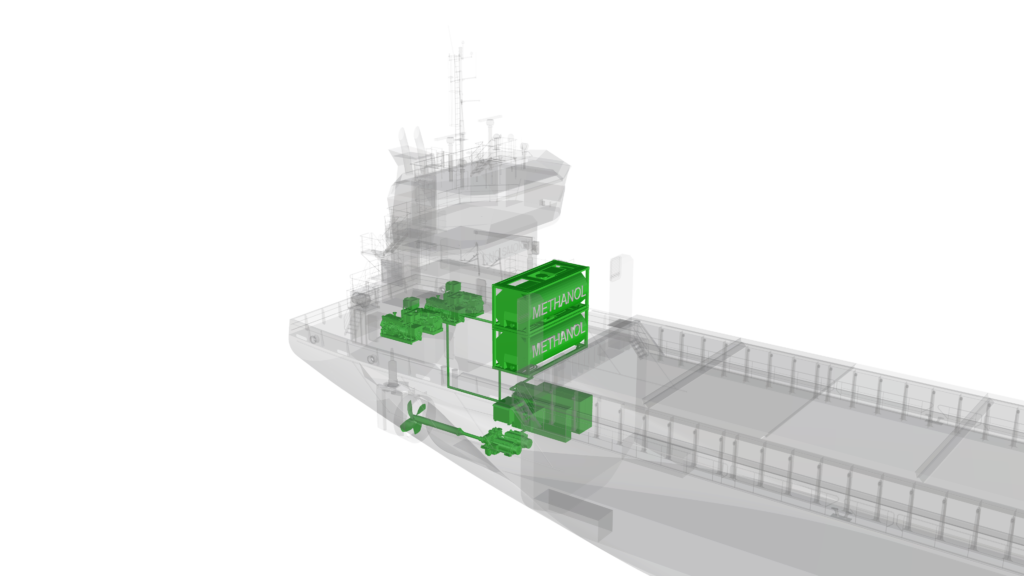
HAZID completed for methanol-fueled Pilot Station Vessel
Conoship leads HAZID for VLOOT’s methanol-fueled PSV, ensuring early risk mitigation and safe, sustainable vessel design.