
Conos, short for Combination Northern Shipbuilders, was an initiative aimed at promoting the commercial interests of its members. With their eyes fixed on sales, the association pursued its goals by holding meetings and creating advertisements in the maritime field. Eventually, Conos determined that their name no longer reflected their involvement with ships. As a result, the new company name, Conoship, was unveiled. This name better captured both their identity and their maritime focus.

As the 1960s approached, the size of the shipyards became a growing concern. Most were too small to operate their own drawing offices due to the high costs involved. The association had to rely on private drafting bureaus; however, this setup disrupted communication between the yards and their technical departments. To overcome this, Conoship experienced another major development: the purchase of a building in Groningen to establish a shared drawing office. This step significantly strengthened the company’s base, adding another stepping stone toward the company it is today.

On June 1st, 1961, the Conoship group booked their first contract. The “I.T.W.A. Pathfinder” was a vessel built on behalf of the Pakistani government.
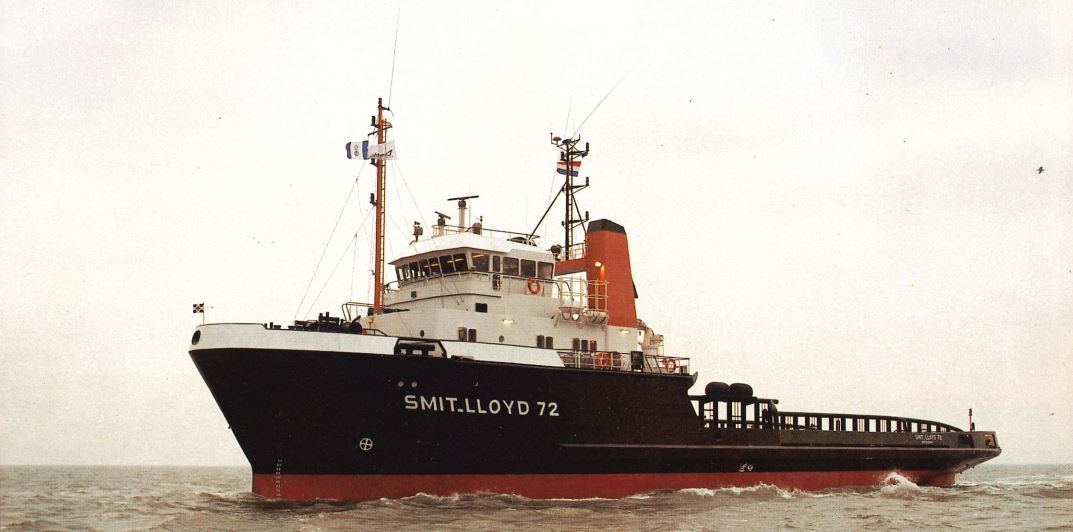
In the 1960s there was a large demand for supply ships and tugs, to support the growing offshore industry. The Dutch Smit-Lloyd became a major player in that market in 1964 with ships of its own design. The so-called supply ship, in ship terms ‘supplier’, looked like a tugboat, but had the function of supplying drilling rigs and providing them with crew members.
The ships were characterized by a high head and detached chimneys placed to the rear so that there was a good view out of the wheelhouse while maneuvering near drilling rigs. The rear deck also presented itself differently. They were flat back decks to carry as much cargo as possible in the form of containers.
At record speed, the suppliers came off the Dutch shipways. Wherever you went or looked, at that time, you saw the Smit-Lloyd ships. Not only in the waters but also on a regular base in the periodical newsletters of Conoship. For several series, Conoship provided the design and engineering, also for the first of a series of four vessels, the Smit-Lloyd 72.

Following the company’s move to Groningen, the members explored the idea of purchasing shipbuilding materials centrally. After some trial and error, it was decided to establish a separate organization focused solely on procurement. This led to the creation of the cooperative “Co-opship,” officially established on January 1st, 1966. Members of Conoship were then required to place large orders through Co-opship, enabling the organization to negotiate significant discounts.

One day in 1978, the Trade Promotion Chamber asked if Conoship would receive a delegation of 20 people at its premises. Without speaking Chinese, Conoship sought someone who could write an introduction about the company. Mr. King, the owner of a Chinese restaurant in Groningen, ended up being the hero—writing the story behind Conoship to present to the guests. This moment marked the beginning of what is now one of Conoship International’s closest alliances.

Conoship had received enough investments to support the building of 6 new modern construction halls by member shipyards. Most of these clients were Dutch and German shipowners, growing the company’s network. In 1997, there were vessels ordered or under construction for 10 different German owners. Conoship’s network then expanded to include Norwegian, Irish, and French shipowners.

On the 1st of November, 2007, the MV “Deo Volente’’ won the prestigious KNVTS Ship of the Year award. After a close collaboration with Hartman Marine BV and Hartman Sea trade, the fastest Multi Purpose Heavy Lift vessel was introduced. This vessel was designed to reach the most technical-economical solution and had a focus on quality, effectiveness, and serviceability.

As time went on, the need to design environmental-friendly vessels started growing in importance. The market started benefiting mainly from low fuel consumption vessels that would still have a high deadweight. This was the opportunity where Conoship began gradually participating in more projects for lengthening or deepening vessels. Additionally, Conoship also began extensive research in close cooperation with MARIN, SasTech, and Delft University of Technology on the vessel’s aft ship, which was believed to be the possibility for the largest efficiency gain. This marked the moment in which the new “eCONOlogic” design was introduced. Application of it was the Lady Anna series leads to the EEDI- Champion in this DWT-class.
As 2012 approached, we introduced a significant advancement: the ConoDuctTail, an innovation designed to maximize propulsive efficiency by optimizing the aft ship shape with a duct, a nozzle, and a large-diameter propeller. This key development was one of the steps that reinforced our entrance into a decade focused on improving fuel efficiency through research and development.

In 2014, a new chapter began after a change of ownership and strategy, the company’s focus on sustainable innovation and green solutions, was strengthened. With this shift, Conoship’s turnover steadily increased, and employment grew by 550%, paving the way for the offices we now have in Groningen, Rotterdam, and Gdańsk, Poland. This evolution in the company’s core activities welcomed projects on wind propulsion, CO2 Capture, robotics, and other initiatives that complemented our existing design and engineering focus.

Following the shift, our Walk to Work vessel, Kroonborg, won the KNVTS Ship of the Year Award in 2015, another recognition reflecting our dedication to environmentally-conscious engineering.

We have always recognized the importance of protecting the waters we travel on, and the KNVTS Maritime Innovation Award for one of our startups, the eConowind unit in 2019, was proof that we were sailing in the right direction.
The easy-to-mount unit was a valuable addition to the sustainability advancements we were exploring. It makes use of existing resources—in this case, the wind—to enable wind-assisted propulsion for both existing and new cargo ships, achieving fuel savings of up to 20%, even 50%. Additionally, the system does not disrupt cargo operations, as it is both movable and foldable.

In the spring of 2022, Conoship International moved into a new office in Groningen, Netherlands. The change of address was small, but it marked a step forward as it better prepared the office for future growth.

In the beginning of 2022, the very first CIP Series standard designs were announced. These future-proof Conoship 3600 tdw general cargo vessels are developed as innovative, and environmentally friendly. To further improve its performance, the design is ready for wind-assisted propulsion, as it is prepared for the placement of two Econowind VentiFoils®, which would reduce the fuel consumption and CO2 emissions by about 10%, depending on sailing route.

With green shipping prioritized, the “ Green Maritime Coalition” was founded on the initiative of the Groningen Maritime Board and Conoship International, with the aim of leading the way in the transition to large-scale zero-emission shipping and digital shipbuilding. The coalition was then handed a cheque of 1.4 million euros from the European Regional Development Fund (EFRO).

In response to the report released by the Intergovernmental Panel on Climate Change (IPCC) which stressed the need for immediate and deep emission reductions across all sectors to fight climate change. For this reason, Conoship became a partner in the ambitious EverLoNG project. The EverLoNG project, led by TNO, was to demonstrate Ship-Based Carbon Capture on board two LNG-fuelled ships, owned and operated by project partners TotalEnergies and Heerema Marine Contractors. With its results, the project aims to bring the technology closer to market readiness.

Bouman Industries and Conoship International started a joint venture to build Ship Based Carbon Capture Systems. The combined expertise of the joint venture enables shipowners and operators to reduce CO2 emissions on their newbuild and existing vessels. By adding a Ship Based Carbon Capture System to capture the CO2 in the exhaust gasses, the shipboard CO2 -emissions can be reduced up to 95 percent.

Adding to our expansion around Europe, Conoship officially opened an office in Rotterdam, perfect to be close to the busy port in the area.

The DGMC aims to transform the challenges faced by the maritime industry into opportunities for innovation and growth. By accelerating the adoption of green technologies such as green methanol, hydrogen propulsion, and onboard CO2 capture, the coalition is paving the way for a more sustainable future. At the same time, digitalization efforts, including robotized shipbuilding and digital twins, will make the industry more efficient and future-proof.